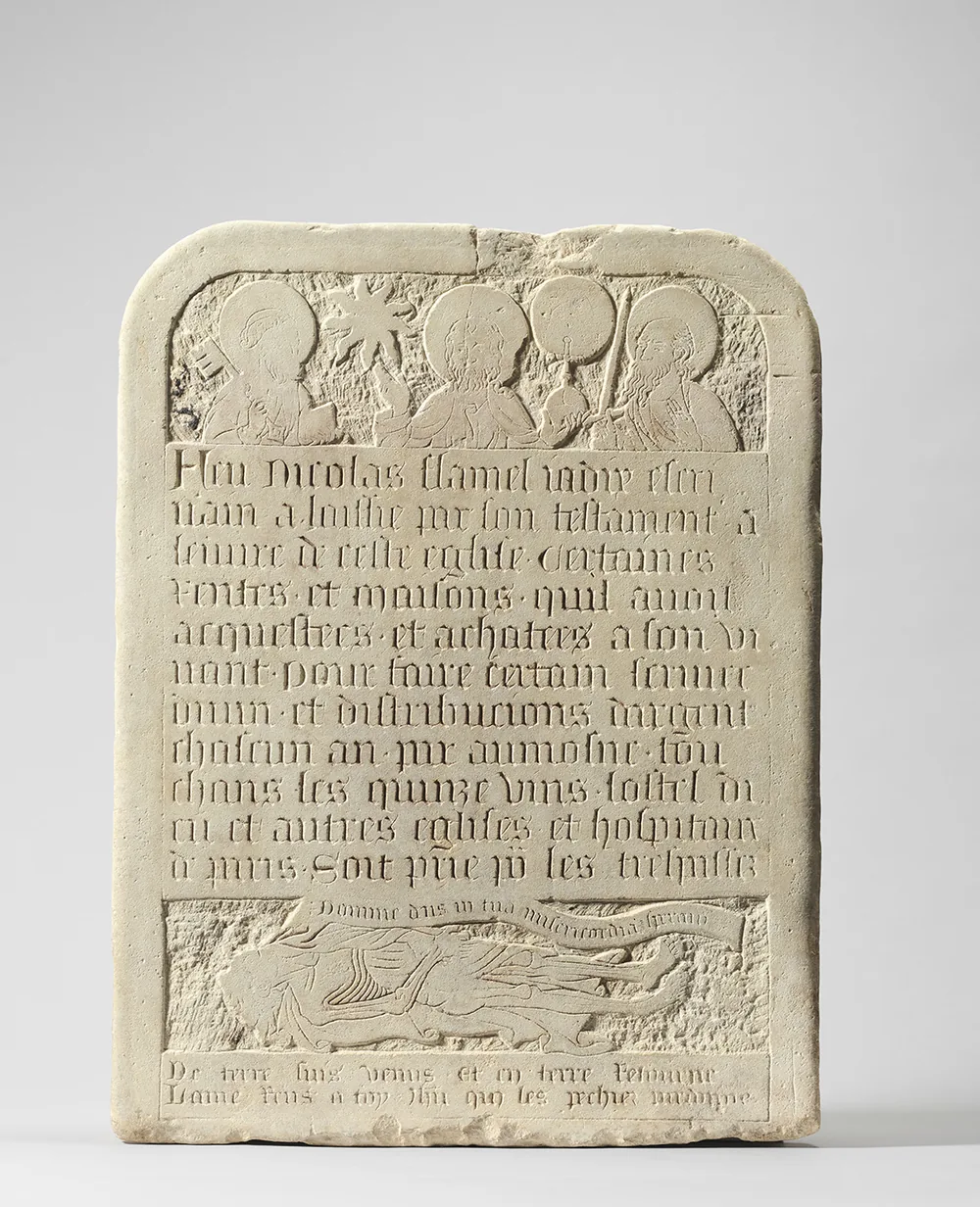
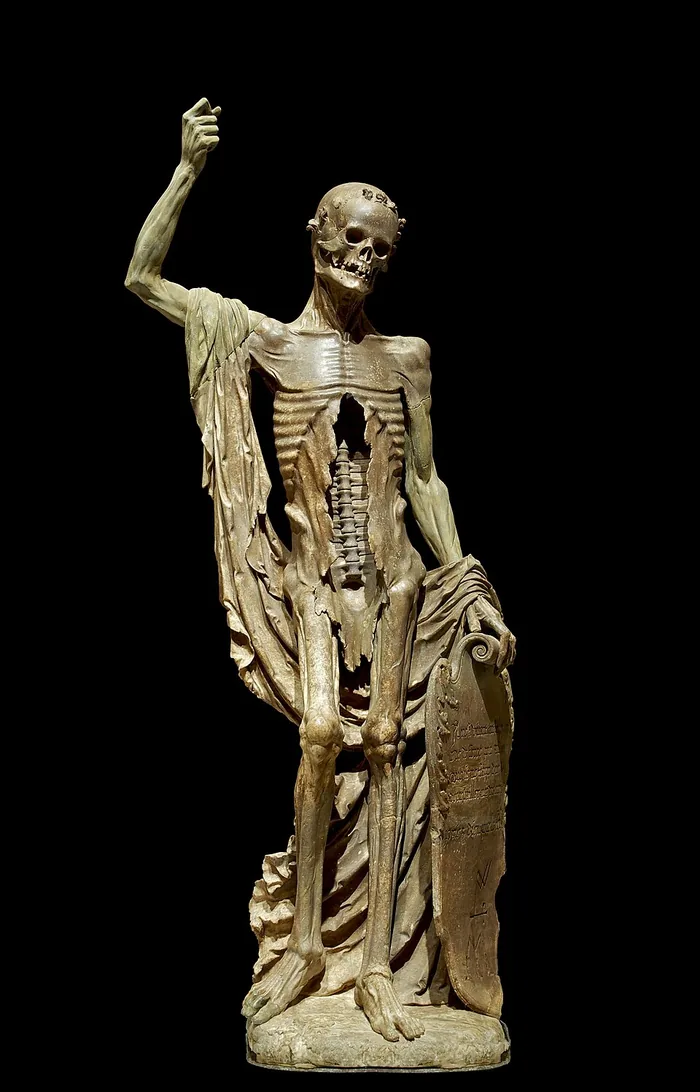
It is a slab of yellowish stone on display at the Musée de Cluny. Right at the bottom, beneath a long Gothic inscription, lies a body, emaciated, given over to decay. Art historians call this a transi, a cadaver effigy. Below it, a single line: “From earth I came and to earth I return.” The dead man’s name is Nicolas Flamel. Yes, the “inventor” of the philosopher’s stone and the elixir of life. The man who, in Harry Potter, calmly clocks up 665 years of age. The most famous immortal in the world took care to announce on his own tomb that he would rot like everyone else. And he was right. To leave is to die a little, as the French saying goes; to die, then, is to rot a lot…
It was in front of this stone that my urge to investigate began to sprout. How did this pious burgher, property developer, married then widowed without children, generous donor to charitable institutions, who had no illusions about the fate of his remains, achieve such fame as an alchemist? For the body, nothing could be done. But for the name, everything was still possible. Masses, foundations, alms, buildings… For some thirty years, Flamel methodically organised his survival in memory. He succeeded beyond all expectation, but not at all as he had planned. Six centuries later, the whole world knows him for what he never was.
Contents
- “Once a scribe…”
- Pernelle, twice widowed
- Three hundred rents
- His face on the walls
- Prayers in the lease
- A will over a metre long
- Enter the alchemist
- Forgery and its uses
- Suddenly, Flamel speaks
- Newton takes notes
- The abbé who killed the myth
- A spinach stall
- “Pray for the departed”
- Bonus: Flamel’s Paris
“Once a scribe…”
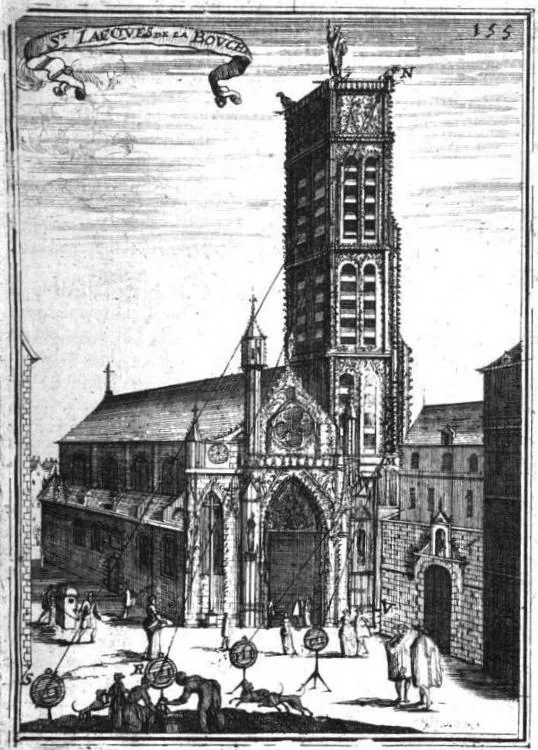
Let us start with what we know about him. It will not take long. His date of birth is unknown: around 1330 or 1340, perhaps in Pontoise. He lived in Paris, in the parish of Saint-Jacques-de-la-Boucherie, whose lone surviving remnant is the Tour Saint-Jacques, standing near the Rue de Rivoli. The records describe him as “escrivain and burgher of Paris”. And that is where things get complicated.
For escrivain tells us very little. Tradition has made him in turn a public letter-writer, a copyist and a bookseller. He may have been all of these at once. But as the exhibition the Musée de Cluny is devoting to him points out (Nicolas Flamel, alchimiste de papier, 13 October 2026 to 24 January 2027), no surviving document settles the question. We know his houses far better than his trade, which already says something about the man. One clue remains, which the Abbé Villain drew in the 18th century from the inventory made in 1399 after Pernelle’s death: Flamel “taught writing at home”, young men lodged with him as boarders, and “courtiers sent him their children”. Several of them still owed him money. So did the king, to the tune of a hundred francs!
A false trail blurs the portrait further. At the same time there was another Flamel, named Jean, secretary and librarian to Jean, Duke of Berry, the famous bibliophile of the Très Riches Heures. It was his hand that recorded the duke’s ownership in his manuscripts, as in the Belles Heures now in New York, with a signature reduced to a single word: “Flamel”. The two men may have been brothers, or merely relatives: in 1434, Guillebert de Mets distinguished “Flamel the elder” from the “young Flamel” attached to the Duke of Berry.
↑ ContentsPernelle, twice widowed
When Nicolas Flamel married, around 1363, his wife Pernelle had already buried two husbands, Raoul Lesthas and Clément de Hanigues. One may wonder whether the young scribe’s starting capital owed something to these two spouses so prematurely torn from their wife’s affection. The archives do not allow us to say so. What they do show is a very well-organised couple.
In 1372, before a notary, the couple made a mutual donation: the survivor would inherit from the other. They would have no children. The first property purchase we know of dates from 1375: an empty plot on which they built their own house, known as “at the Fleur de Lys”, on the corner of the Rue des Écrivains (Scribes’ Street) and the Rue de Marivaux, right opposite the church. Needless to say, the name of the first street lent credibility to his profession. The Rue des Écrivains has vanished beneath the Rue de Rivoli, and the Rue de Marivaux has become the Rue Nicolas-Flamel. To find the house, stand where that street meets the Rue de Rivoli, facing the Tour Saint-Jacques: it stood a few metres to your right.
On 25 August 1397, Pernelle, now ill, dictated a will that overturned the donation and named her husband only to revoke it. Villain suspected the hand of her sister Isabelle and her brother-in-law, the tavern keeper Jean Perrier. Ten days later, a codicil restored everything: Flamel became once more her “dear and good friend, companion and husband”. She died on 11 September. Perrier had the property seized, lost before the Châtelet court and went away with 300 livres for his wife and 40 gold écus for his children. Flamel went on buying, alone this time. Legend would turn Pernelle into the laboratory partner of an adept, immortal at his side. More prosaically, the archives portray an heiress whose stormy succession kept the judges busy.
↑ ContentsThree hundred rents
For our scribe friend bought a great deal. The documents allow us to reconstruct some ten houses in Paris and nearly 300 rents, in the capital and its surroundings. In the Middle Ages, a rent was a sum of money paid to a property owner: in exchange, you acquired the right to receive a guaranteed yearly income secured on his house. It was an investment, safe and regular, at a time when the Church forbade lending at interest. The future “alchemist” was in fact building a property portfolio far more profitable than uncertain experiments with retorts and stills in a smoky cellar.
He also had a head for business. The new city wall of Paris, completed around 1380, had just enclosed vast areas on the Right Bank. Flamel placed his bets in these still sparsely built districts, notably south of the priory of Saint-Martin-des-Champs (today’s Musée des Arts et Métiers). Was this a deliberate calculation? We have no idea. But a Greater Paris investor today would do exactly the same. To locate these properties, see the map at the end of the article.
So there is no need for lead turned into gold to explain this fortune. At least for anyone who takes the time to read the deeds. For everyone else, a mystery remains: how did a mere “scribe” become so rich?
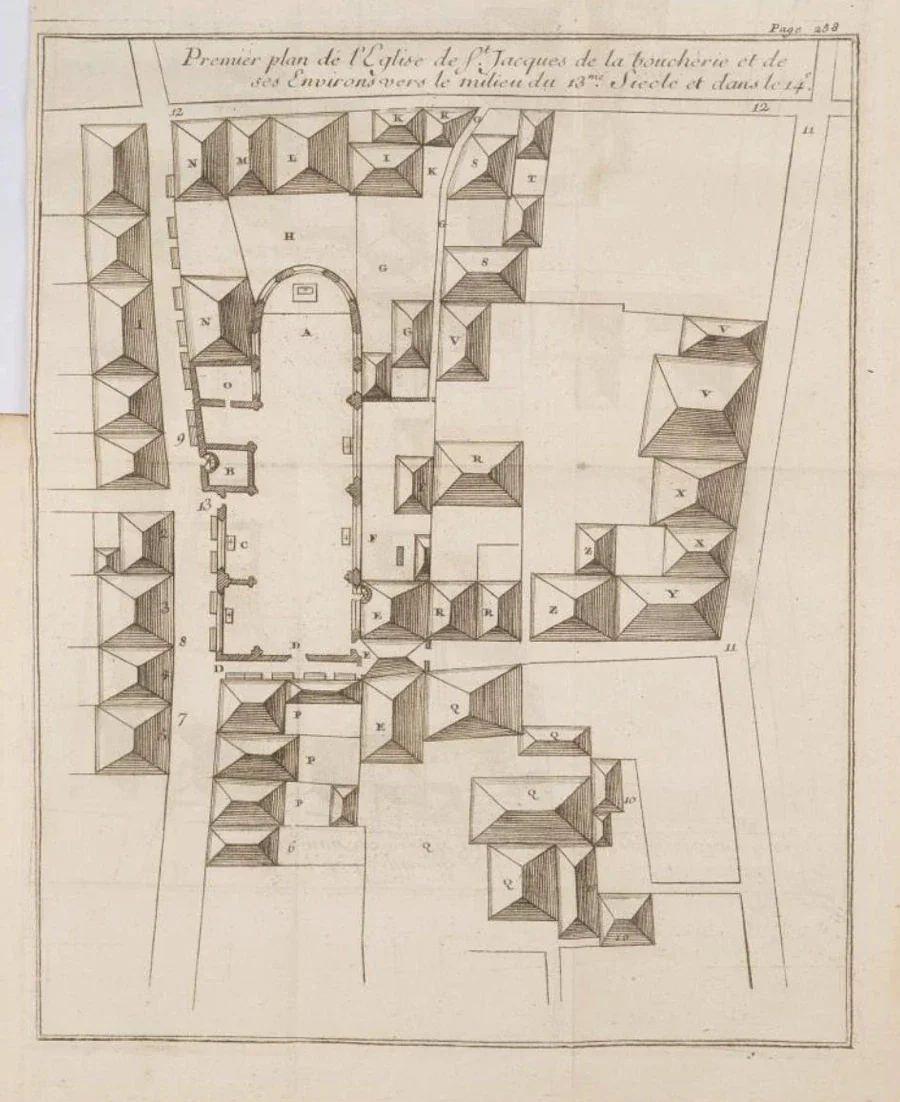
The most surprising part? He never left his workplace. Near the bell tower, the couple owned two scribes’ stalls built against the wall of the church, opposite the Rue de Marivaux. Each measured five feet by two, about 1.60 m by 65 cm. By 1445 they could no longer even be let, “because the place is small”. He went on working there once he was rich, notes Villain, who adds: “His name, moreover, might not have come down to us, had he chosen to live as a man of fortune.”
↑ ContentsHis face on the walls
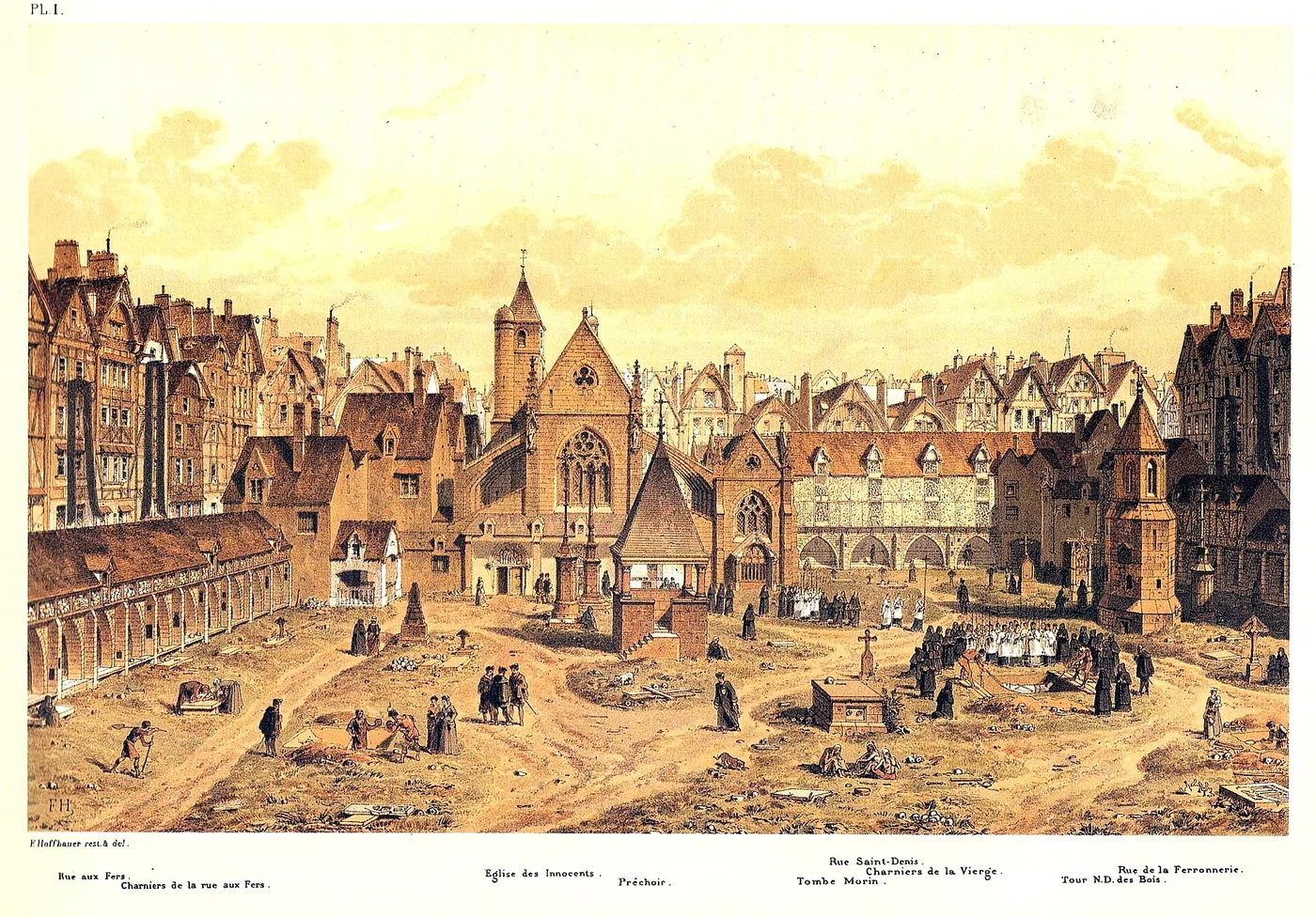
Once free from want, Flamel embarked on another venture. He paid for the rebuilding of the small doorway of his parish church, in 1389 according to the Cluny exhibition, in 1399 according to Sauval and Lebeuf. He and Pernelle had themselves depicted kneeling before the Virgin, presented by Saint James and Saint John the Baptist. The same year, in the cemetery of the Holy Innocents (where the fountain of the same name stands today), he commissioned an arch on which the couple appear at the feet of Christ, surrounded by angels. In 1402, he contributed to the restoration of Sainte-Geneviève-des-Ardents (traces of its apse can be seen on the ground, west of the square in front of Notre-Dame). There he had himself portrayed in prayer, wearing a long hooded tunic. His portrait also adorned the front of his own house.
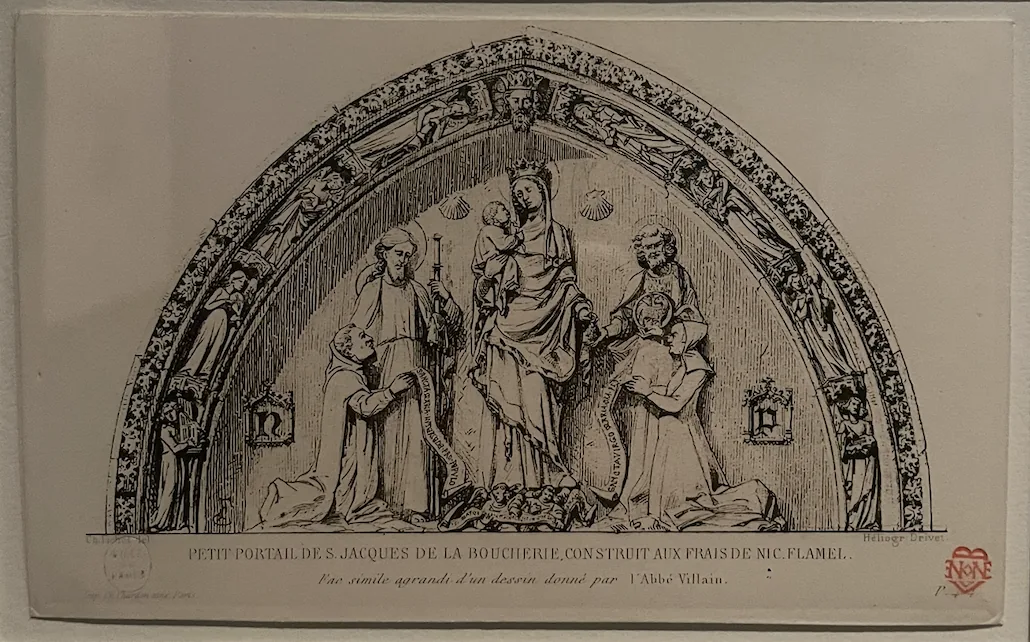
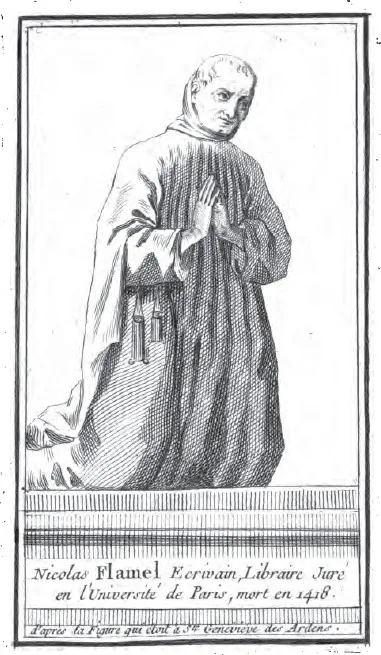
There is no need to mock the vanity of a pious upstart. In the Middle Ages, these images served two purposes that were in no way opposed. They asked passers-by for a prayer for the donor’s soul, and salvation was partly at stake there. They also wrote his name into the cityscape. Securing one’s salvation and being seen were one and the same gesture.
In the mid-18th century, these images were still numerous enough for a Parisian to follow a genuine sightseeing route in Flamel’s footsteps. Almost all of them have since disappeared, along with the buildings that housed them. But let us remember above all the arch at the Innocents. This ordinary monument of piety was to enjoy an afterlife its patron would never have dared imagine.
Prayers in the lease
There is one place where you can still see this machinery at work. At 51 Rue de Montmorency, on the edge of the Marais, stands a tall stone house, often described as the oldest in Paris, now a restaurant. It is called the “House of Nicolas Flamel”, although nothing suggests he ever lived there. Contrary to what one might think, he bought many houses but built rather few. This one is an exception. Look up at the façade and read:
“Nous homes et femes laboureurs demourans ou porche de ceste maison qui fut faite en l’an de grâce mil quatre cens et sept somes tenus chascun en droit soy dire tous les jours une paternostre et un ave maria en priant Dieu que sa grâce face pardon aus povres pescheurs trespasses. Amen.”
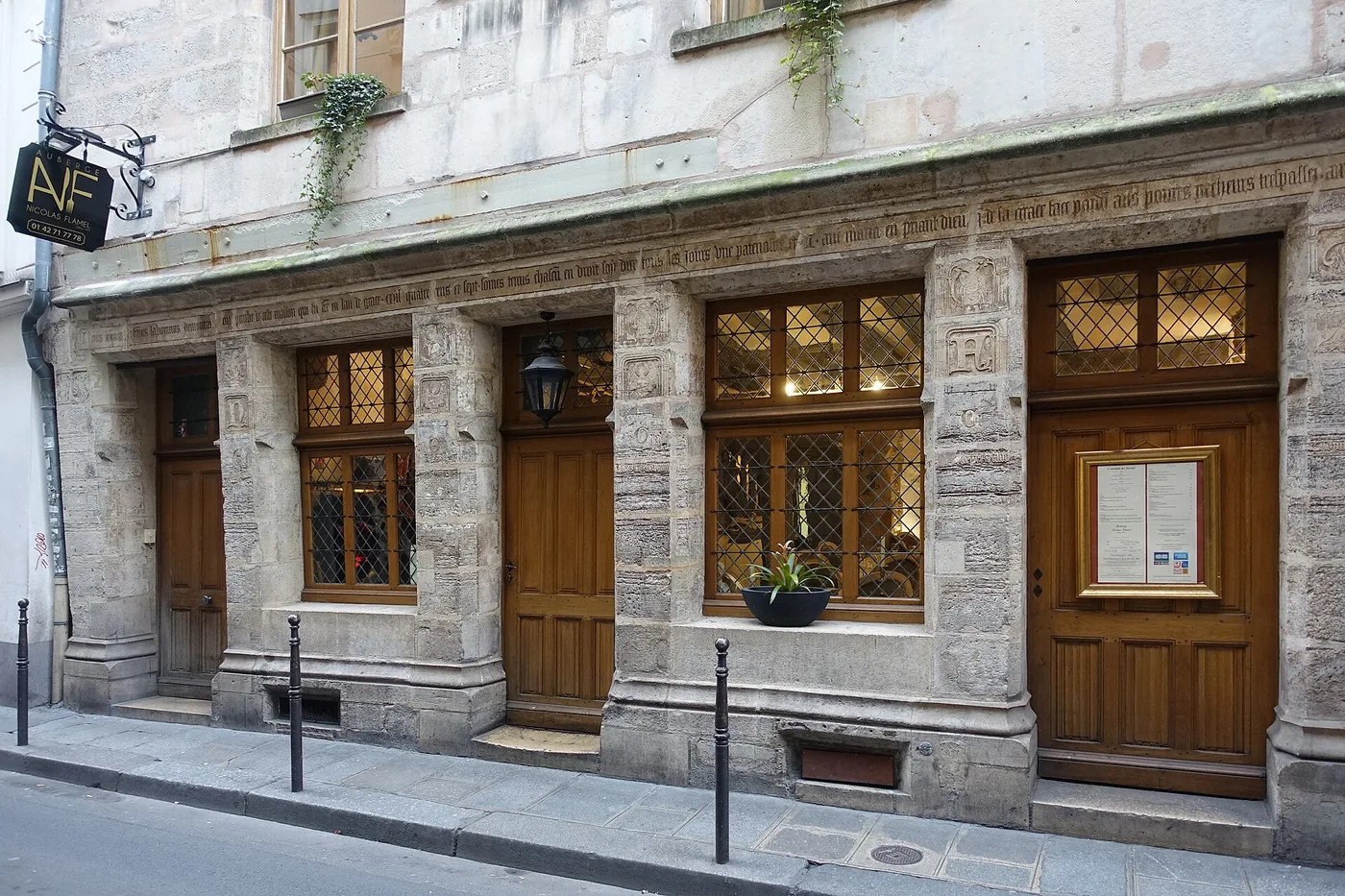
In other words: “We, men and women labourers living in the porch of this house, built in the year of grace fourteen hundred and seven, are each bound to say every day a Paternoster and an Ave Maria, praying God that His grace may pardon the poor departed sinners.” In 1434, Guillebert de Mets described the arrangement: Flamel “built several houses where craftsmen lived below, and from the rent they paid poor labourers were kept above”. So the craftsmen paid for the poor. But the details escape us: the parish registers mention a rent for the “porch” of one of these houses, that is, the ground floor, and in 1560 the parish proved in court that they were not hospitals. Let us call it one of the most unusual leases in the history of Paris.
The inscription asks for prayers for all dead sinners, among whom the owner fully intended to be counted. Although it does not name Flamel, his initials can still be seen on the façade and, on the right, a small medallion traditionally said to be his portrait. Its condition and size, however, make it impossible to be sure.
↑ ContentsA will over a metre long
On 22 November 1416, still sound in body and mind, Nicolas Flamel dictated his last wishes to two notaries of the Châtelet. The document, over a metre long, entered the Archives nationales in 2025 with the historical records of the Quinze-Vingts hospital. Thanks to the Abbé Villain, we can read its detailed contents (in French). A marvel of celestial bookkeeping…
First, the location. Flamel wished to be buried in Saint-Jacques-de-la-Boucherie, before the crucifix and the Virgin, and he had already paid the fourteen francs owed to the church fabric for the site of his grave. For the tombstone, he specified that the one at his home should be used. So he kept it somewhere in his house. This is sublime: the man dictating his epitaph kept at home the ready-made image of his own corpse.
The programme is of biblical precision:
- Fifty low masses on the day of the burial, for 100 sols parisis
- 32 sols for ringing the bells
- A Requiem mass every day for seven years and forty days
- A solemn service every Friday
- Twelve yearly obits (memorial services) in perpetuity, one a month, funded by 180 livres parisis in rents
For such a commitment to last forever, it has to be funded ad vitam aeternam, and that is what the rents are for. From now on, they would do the praying for him.
He even thought about the congregation. Up to thirteen poor people would receive 12 deniers each to play the mourners during the services. And if seven blind men from the Quinze-Vingts wished to come, they would be given preference. The prayers of the poor were thought to be the most effective with God: best to make sure they attended. His parish was named legatee of his houses and rents, on condition that it carry out the whole programme. Whatever remained would be shared between the fabric of Saint-Jacques, Sainte-Geneviève, Notre-Dame and the Hôtel-Dieu.
↑ ContentsEnter the alchemist
Nicolas Flamel gave up the ghost on 22 March 1418. Some books give 1417: in the Paris of the day, the year changed at Easter, which that year fell on 27 March. For his contemporaries, 22 March still belonged to 1417. Above his tomb was placed the famous stone that can now be seen at Cluny:
“The late Nicolas Flamel, once a scribe, has left by his will to the fabric of this church certain rents and houses which he had acquired and purchased in his lifetime, to perform certain divine services and distributions of money each year as alms, concerning the Quinze-Vingts, the Hôtel-Dieu and other churches and hospitals in Paris. Pray for the departed.”
Not a word about his merits, his family or his dates. The stone works like a poster: here is what I gave and to whom, and you who pass by without seeing me, pray. At the top, Christ between Saint Peter and Saint Paul, the sun and the moon. At the foot of the text, the cadaver, a Latin prayer, a final allusive line about the earth and a last plea for forgiveness. The man presents himself as a corpse, and his gifts as his only title.
And it worked. In 1434, sixteen years after his death, Guillebert de Mets, in his description of Paris, remembered “Flamel the elder, a scribe who gave so many alms and so much hospitality”. Flamel’s foundations would be celebrated until the eve of the French Revolution, for more than three and a half centuries. Pernelle was less fortunate: the prayers ordered for her were only partly said, for lack of funds.
And here comes the twist that heralds Flamel’s change of status. In 1463 a lawsuit opened between the church and the Quinze-Vingts, who claimed that the deceased had left more than 800 livres in rents. The churchwardens replied with the accounts: between his death and 1426, they had received 2,052 livres and spent 2,349. The will was costing them money! Flamel, they argued, “was reputed to be a richer man than he was”. According to Villain, he did not leave 300 livres in rents. Half a century after his death, his fortune had begun to grow all by itself. It could be seen everywhere, on the doorways, the arches, the houses and the tombstones. But where did it come from? Strange, don’t you think? All that was missing was an explanation. Even a posthumous one.
↑ ContentsForgery and its uses
It arrived at the end of the 15th century in the form of a manuscript. The Livre Flamel, one copy of which is now held by the University Library of Bologna, is the oldest treatise on alchemy bearing this name. It sets out a theory of transmutation and a six-step recipe. It appeared at least fifty years after Nicolas Flamel’s death, and it is signed simply “Flamel”, with no first name. Yet the text is anything but original: it is the French translation of a Latin treatise, the Flos florum, attributed to Arnald of Villanova. But putting it under the name of a Parisian whose fortune had become mysterious gave the legend one hell of a boost.
All the more so as a forger joined in by circulating the Livre des laveures, a translation of the Rosarius by the English alchemist John Dastin, whose name it originally bore. Someone scraped it off and wrote in its place: Flamel. Why him? Because beyond scholarly quarrels, alchemy had a serious marketing problem: how do you convince the reader that your recipe works? The best argument would be a man who had really become rich. And as it happened there was one in Paris, with the double advantage of being dead and unable to protest. Historians have a learned name for this practice: pseudepigraphy.
In the 16th century, the story took shape. In 1561 a Sommaire philosophique in verse appeared under Flamel’s name. In 1578, Noël du Fail wrote that he had become one of the richest men of his time after finding “in an old book a metallic recipe”. In 1584, the Sieur de La Croix du Maine reported quite another rumour, less poetic: the scribe had grown rich on the debts owed to the Jews expelled from the kingdom in 1394. Explanations multiplied, and none of them bothered with the notarial deeds. And Flamel’s name began to cross borders: Germany in 1605, England in 1610.
↑ ContentsSuddenly, Flamel speaks
The masterstroke came in 1612. A certain Pierre Arnauld de la Chevallerie published in Paris a Livre des figures hiéroglyphiques (Book of Hieroglyphic Figures), presented as the translation of a Latin text by Nicolas Flamel himself! For the first time, this was no longer a recipe. It was Nicolas Flamel speaking, in the first person, and telling all!
The story is gripping. The humble scribe buys a mysterious book for two florins, the book of Abraham the Jew. For more than twenty years he tries to decipher it. He sets off on the road to Compostela and, on his way back, meets a Jewish sage, Master Canches, who gives him the key. On 25 April 1382, in his laboratory, with Pernelle as his devoted assistant, he finally achieves the transmutation: mercury turns into gold. And to pass his secret on to posterity without giving it away, the crafty alchemist supposedly had it carved in stone. Where? On the arch in the cemetery of the Innocents, of course!
Flamel had commissioned that arch so that people would pray for him. The kneeling couple, Christ and the angels, this whole perfectly ordinary programme of piety, became a coded message. Because the arch existed, the legendary tale seemed true. Because it seemed true, the arch became proof. Any 17th-century Parisian could go and check on the spot. The means our man had used to secure his memory now served to hijack it.
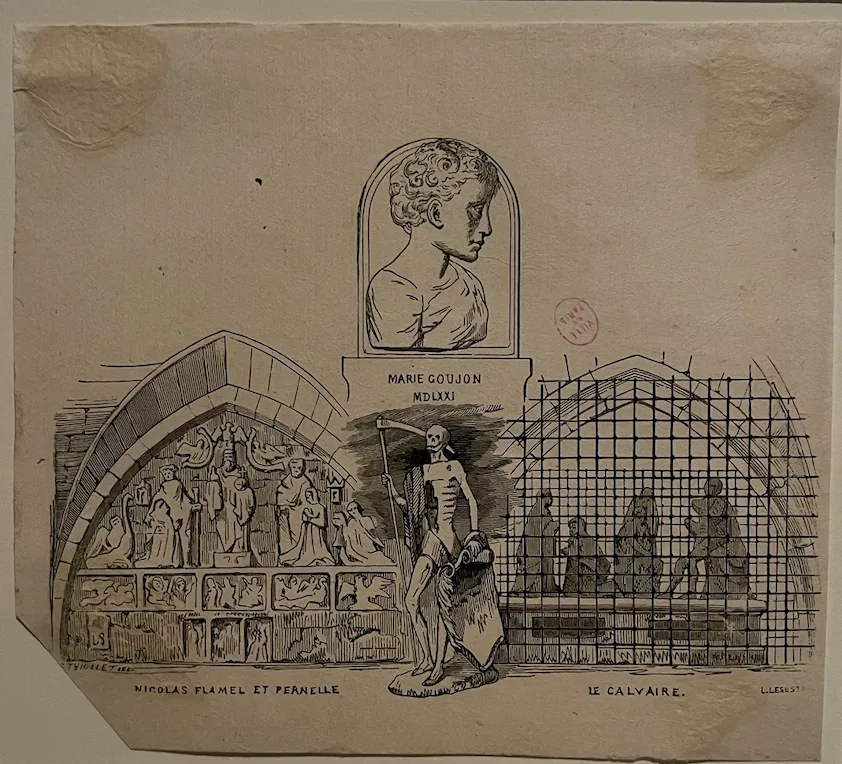
It is, of course, a forgery. Didier Kahn, a specialist in Renaissance alchemy, concludes that it was probably fabricated shortly before its publication and that the Latin original never existed. The text gives itself away: it mentions Lambsprinck, an alchemical author with the serious drawback of not appearing in the records before 1599, long after the death of the so-called alchemist author. Who was behind it? The Quebec historian Claude Gagnon has proposed François Béroalde de Verville, poet and lover of the Kabbalah, on the strength of anagram games. The theory is not universally accepted. But no matter… The historical figure became the narrator of his own legend.
↑ ContentsNewton takes notes
From then on, Flamel became a myth. His texts were translated and included in the great scholarly compilations of Europe, from the Musaeum Hermeticum to the Bibliotheca Chemica Curiosa. An English version appeared as early as 1624. And it was in this edition that a certain Cambridge reader, around 1680, came to take notes.
Isaac Newton, for it was he, copied out and annotated the book, and went so far as to draw the arch of the Innocents in his own hand, though he had never seen it. To sum up: the father of universal gravitation pored over a Parisian forgery to reproduce a devotional monument as if it were one of his equations. It should be said that at the time, alchemy had not yet been cast out of science, and our opposition between the two would have been an anachronism to him.
The powerful joined in too. According to a rumour reported in 1655 by Pierre Borel, Flamel’s house was searched for the book of Abraham, which Richelieu supposedly obtained shortly before his death. Only one last step remained. In 1712, the traveller Paul Lucas reported, without quite believing his own tale, what a dervish in Turkey had told him: the philosopher’s stone prolongs life by a thousand years, and the dervish himself had met Flamel in India three years earlier. Thanks to the man who saw the man who saw the dervish, the man who had his own corpse carved in stone was officially alive.
↑ ContentsThe abbé who killed the myth
All this time, rather as with the Templars, nobody had thought of checking these tall tales in the archives. And here I, who have made a profession of torpedoing legends, humbly bow before Father Étienne-François Villain. This Parisian abbé was working on the history of the parish of Saint-Jacques-de-la-Boucherie, published an essay on it in 1758 and reproduced Flamel’s will in it. In 1761, he did it again with a Histoire critique de Nicolas Flamel et de Pernelle sa femme (Critical History of Nicolas Flamel and Pernelle his Wife, illustrated here). His method was breathtakingly innovative: he read the parchments, established and cross-checked the facts, and concluded that the alchemical writings looked more like a tissue of nonsense than a doctoral thesis.
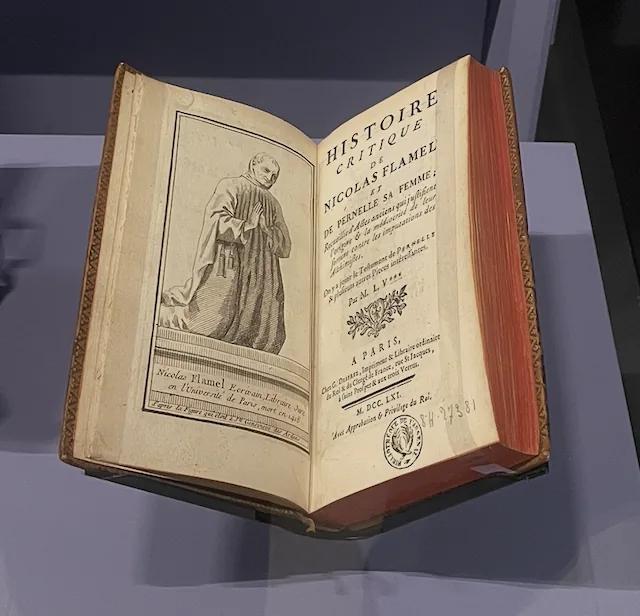
I confess a certain fondness for this methodical cleric. What he did is what every licensed guide ought to do when faced with a good story: go back to the source and check what it says. It is admittedly less fun. But so much more fascinating! A century later, in 1857, Vallet de Viriville carried on the work, and Albert Poisson published a book on his life and foundations in 1893. It was not until the mid-20th century that research clearly established that nothing allows us to make Flamel an alchemist of any kind.
The effect of these investigations on the public? Next to none. Villain experienced it himself while his book was in press. In the summer of 1756, a stranger turned up at the parish: a late friend had supposedly entrusted him with pious works, and he offered 3,000 livres to repair the old house on the corner of the Rue de Marivaux. The offer was accepted. His men dug in the presence of strange backers, found nothing, and then turned on the carved stones of the façade, which were supposed to contain the gold. They were “removed, broken and turned into rubble: that is all the gold that was found”. Then the whole crew vanished without paying for the work in full. Even today, visitors grumble when the Musée de Cluny has to take the “alchemist’s” tombstone off display for a while. And as you pass the so-called Flamel house in the Rue de Montmorency, it is not unusual to see inspired esotericists stroking the inscriptions on the façade to feel vibrations from the depths of time… The legend is now old enough and beautiful enough to do without the man who unwittingly inspired it. It is a constant in our profession, as we saw with Cardinal Balue’s iron cage and with the Templars: once a story has taken root, documents will not dislodge it.
↑ ContentsA spinach stall
Meanwhile, what became of the real Flamel? The Revolution swept everything away. Saint-Jacques-de-la-Boucherie, closed in 1790, was sold as national property in 1797 and dismantled stone by stone. Only the Tour Saint-Jacques survived, built in the early 16th century, long after the death of its illustrious parishioner. The last remnant of his church is thus a bell tower he never saw. The masses stopped. The bones of Nicolas, buried at Saint-Jacques, and of Pernelle, buried at the Innocents, ended up in the Catacombs, impossible to find among millions of others. The cadaver on the stone would be hard pressed to gather up his bones.
The tombstone, for its part, disappeared. It turned up again in the early 19th century: a curiosity dealer spotted it at a greengrocer’s, who used it to display her spinach, or to chop it, nobody really knows. Around 1833, the stone passed to another dealer. In 1839, it was brought to the attention of Rambuteau, Prefect of the Seine, and the City of Paris bought it for 200 francs. It entered the Musée de Cluny in 1845.
At the very moment this stone was serving as a vegetable stand, Paris became infatuated with its owner. In 1831, in Notre-Dame de Paris (The Hunchback of Notre-Dame), a novel whose setting can still be found around the cathedral, Victor Hugo sends his alchemist archdeacon, Claude Frollo, to dig in Flamel’s cellars. Gérard de Nerval began a play about him, left unfinished. In La Tour Saint-Jacques, Alexandre Dumas makes him the physician of Charles VI, murdered by a ruffian. Flamel no longer had anything to do with Flamel: he had become raw material, available to every author.
In 1852, the city named two streets near the tower “Nicolas Flamel” and “Pernelle”. In 1893, a night shelter for poor workers took his name. In 1900, at the Universal Exhibition, Albert Robida featured him in miniature in his reconstruction of Old Paris.
↑ Contents“Pray for the departed”
The 20th century took care of the rest. In 1929, in the Second Manifesto of Surrealism, André Breton summoned Flamel: alchemy became an image of poetic creation, and the philosopher’s stone an image of the liberated imagination. The ground was ready for the final metamorphosis. In 1997, in the first Harry Potter book, J. K. Rowling made Nicolas Flamel the only known maker of the philosopher’s stone, a friend of Dumbledore and a peaceful pensioner. Children all over the world learned the name. Tourists photograph the Rue de Montmorency.
Today, his foundations have disappeared with the Ancien Régime. His houses have been demolished or altered. His portraits have almost all been lost. The Quinze-Vingts hospital still exists and has handed its archives to the State, but no mass is said for the donor any more. Of the vast system built between 1389 and 1418, there remain one house, one will and a limestone slab that has known Popeye’s favourite vegetable.
But Flamel won! He wanted his name to be spoken after his death, and it is spoken, every day, in every language. He simply obtained it at a price no notary could have written into the contract: becoming what he almost certainly never was, and seeing forgotten what he had paid to be. The adept of 1612, the traveller in India and Dumbledore’s friend have taken his place. He remains at Cluny, for anyone willing to push the door, with his carved corpse and his last request, which we can at least read aloud for him:
↑ Contents“De terre suis venus et en terre retourne.” (From earth I came and to earth I return.)
Every tour by La Compagnie des Guides is nourished by investigations like this one. What we discover, we share with you.
Bonus: Nicolas Flamel’s Paris
The Musée de Cluny exhibition shows a map of Flamel’s properties, based on archives not yet published. It is not reproduced here. But Flamel left his own geography: his will and the registers read by the Abbé Villain name his houses, his rents and the places from which he asked for prayers. We have plotted them on the present-day map of Paris. Tap a point to see what stood there.
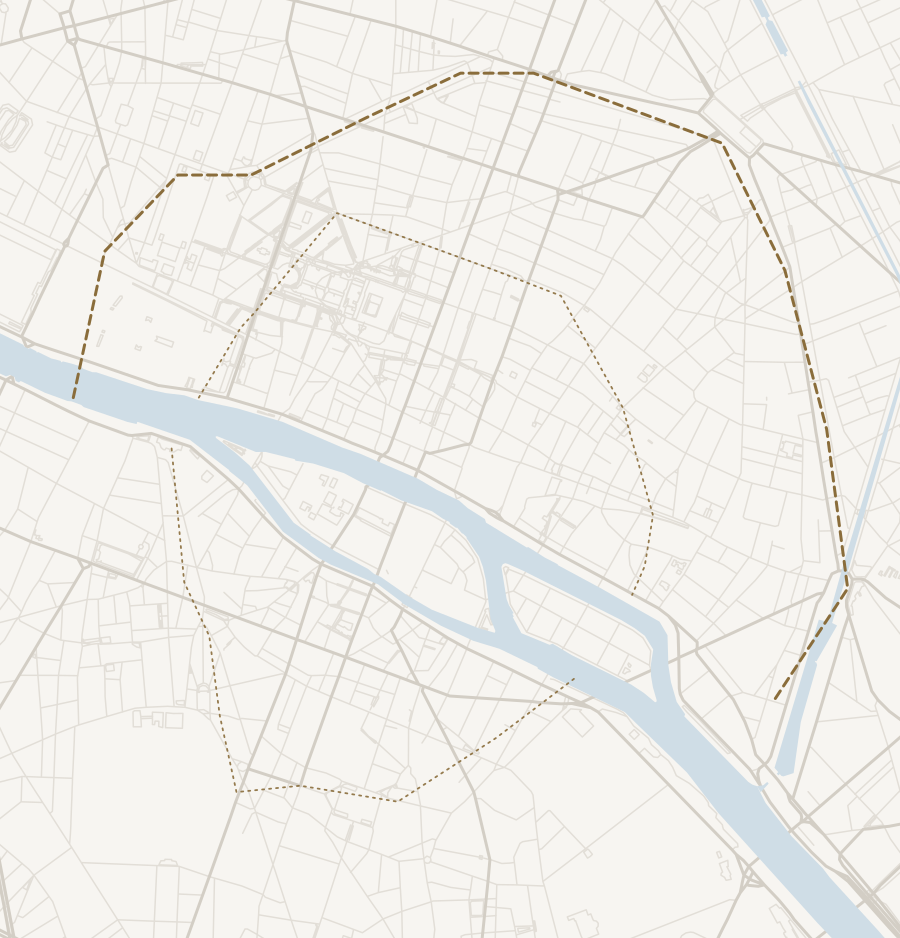
- His houses and stalls
- Buildings bearing his image
- His tombstone today
- The 28 other places named in the will
- Wall of Charles V
- Wall of Philip Augustus
Two things stand out. His properties fit in a pocket handkerchief, between Saint-Jacques and the Rue de Montmorency, just beyond the old city wall. His bequests, on the other hand, cover the whole city: at his death, almost every district had a reason to speak his name.
Around Saint-Jacques. The Fleur de Lys house, built on “an empty plot”: the will speaks of his “undivided half of a house forming the corner of the Rue Marivaux”. Next door, the house with the sign of Saint Nicholas, “which belonged to Nicolas Flamel”. Against the church wall, the two stalls. Villain’s plan locates them one by one.
Rue de Montmorency. The will mentions his “tenants” in “his houses beyond the Porte Saint-Martin”, probably the old gate of Philip Augustus’s wall, close by, and “the tall house where the well is”. The parish registers record there “first letting 12 sols, second letting upstairs 8 sols”. Only the house at no. 51 survives.
The Innocents and Sainte-Geneviève-des-Ardents. These were not properties but building projects, where he had his image carved. In 1470, the churchwardens of Saint-Jacques were still opposing the demolition of what he had built at the charnel houses.
Beyond the walls: the country rents
The houses were only the visible part. “His property in the countryside consisted of a quantity of small rents,” writes Villain. The will names four villages, and there he looks after his debtors: to those who sold him rents “living at Nanterre, at Rueil, at Issy and at La Villette-Saint-Ladre”, he remits half of their arrears and offers to let them buy the rents back at the purchase price. He also has cloth distributed there to clothe 80 people, on condition that they wear it and do not sell it. And half the wine from his Nanterre rents goes to his servant Margot and her daughter Colette.
The full text, in French, is on the page Le testament de Nicolas Flamel.
↑ Contents